Source: SEO Blog by Aleyda by Aleyda Solis. Read the original article
TL;DR Summary of What It Takes for SaaS Brands to Win in AI Search: 5 Data-Backed Findings and Actions
SaaS brands must strategically optimize both their own content and external ecosystems to succeed in AI search results. AI platforms like ChatGPT and Google AI Mode rely on different types of evidence, requiring tailored distribution approaches for each. Citations and traffic destinations often differ significantly, so brands need to measure and optimize these layers separately. Finally, customizing strategies by SaaS subvertical and primary user job ensures relevance and maximizes AI-driven engagement.
Optimixed’s Overview: Key Strategies for SaaS Brands to Dominate AI-Driven Search Visibility
Understanding the AI Search Landscape for SaaS Brands
Recent analysis of 15 leading SaaS ecosystems reveals that AI search engines such as ChatGPT and Google AI Mode integrate diverse sources and user journeys in delivering answers. Success in AI search depends on managing three interconnected layers:
- Brand-owned pages earning citations that help AI explain or recommend products.
- Third-party external sources providing supporting evidence that heavily influence AI responses.
- Actual referral destinations users or AI agents visit after receiving AI-generated recommendations.
These layers often serve different purposes and require tailored optimization approaches.
Five Critical Patterns Shaping SaaS AI Search Optimization
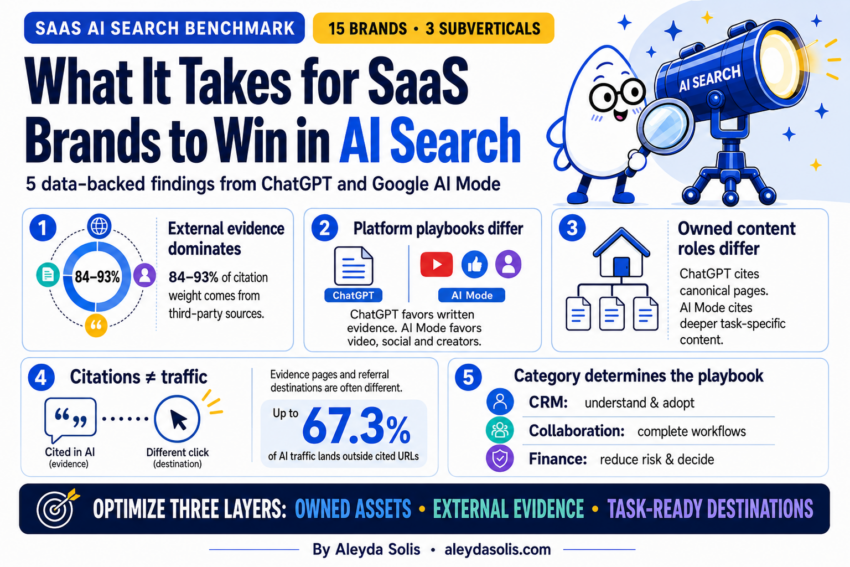
- External sources dominate AI citation weight, contributing 84% to 93% of references. SaaS brands must develop dedicated strategies for third-party ecosystems such as communities, reviews, and publishers rather than relying solely on owned content.
- ChatGPT favors structured written content (e.g., technology publications, review sites), while AI Mode prioritizes video, social media, and creator content. Brands need separate distribution programs to address these distinct evidence ecosystems effectively.
- Different website pages are cited by each AI platform. ChatGPT often cites corporate homepages and canonical brand pages, whereas AI Mode focuses on deeper content like guides, documentation, templates, and integrations. Both layers must be optimized and internally linked to guide users toward conversion.
- Citation pages frequently differ from actual traffic destinations. For example, users might discover product explanations through cited pages but complete actions on pricing, app access, or authorization pages. Reporting citation and referral metrics separately enables better performance insights.
- No universal AI search playbook exists for SaaS. Strategies must align with the primary user job by subvertical—CRM focuses on understanding and adoption, collaboration on workflow completion, and finance on risk reduction and decision-making.
Actionable Recommendations for SaaS Brands
- Map your external evidence ecosystem specific to your SaaS category before investing in AI visibility efforts.
- Run dual distribution programs—one targeting evaluative written content for ChatGPT and another focusing on video, social, and community engagement for AI Mode.
- Ensure owned pages are task-ready with clear next steps, linking cited content to conversion-focused destinations such as pricing, sign-up, or app access pages.
- Measure AI visibility in layers—track citations, external authority, referrals, and business actions individually for accurate insights.
- Customize your content strategy by SaaS subvertical, investing in the assets and external sources that support your category’s dominant user job.
Conclusion: Building Sustainable AI Search Authority in SaaS
SaaS brands that understand the distinct AI evidence ecosystems, optimize their owned and external pages accordingly, and measure visibility across multiple layers will outperform competitors. Embracing category-specific strategies and continuously monitoring AI platform changes will enable brands to capture high-value AI-driven traffic and conversions effectively.