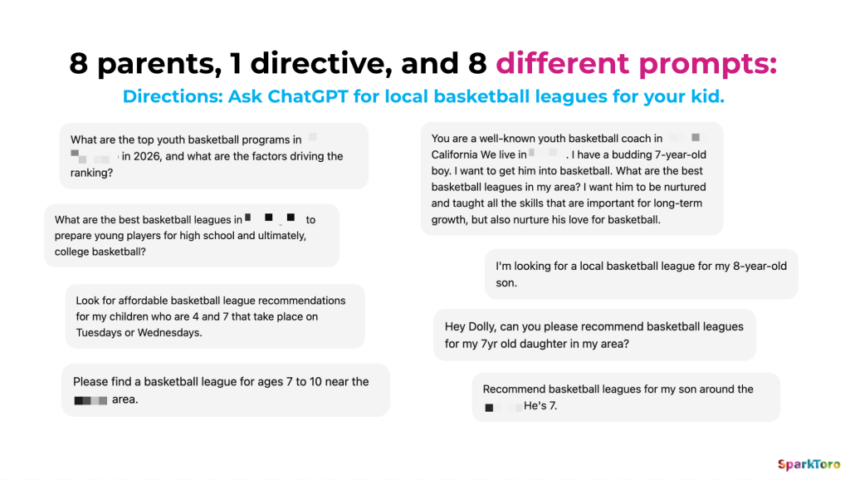
TL;DR Summary of How Diverse AI Prompts Reveal the True Challenge of AI Visibility for Marketers
Optimixed’s Overview: Why Understanding User Language Diversity Is Key to Winning AI-Driven Search
The Complexity Behind AI Visibility
Recent experiments and large-scale research reveal that when people ask AI for recommendations—such as finding a local basketball league—they rarely use similar phrasing. Instead, queries vary widely in wording, context, and emphasis, reflecting individual perspectives and priorities. This diversity challenges conventional SEO and keyword strategies, which often assume a limited set of popular queries to optimize for.
Key Insights from SparkToro and Gumshoe Research
- Low semantic similarity: People’s prompts for the same intent score very low on similarity, indicating highly varied language.
- AI consistency: Despite diverse inputs, AI recommendations tend to cluster around similar brands or answers, showing strong intent recognition.
- Audience research first: The main task for marketers is to understand how their audience talks about problems, including the words, qualifiers, and constraints they use.
Implications for Marketers and Content Creators
To improve AI visibility, marketers should focus on:
- Listening to real user language: Analyze forums, reviews, social media, and customer interactions to capture authentic phrasing and concerns.
- Creating content that reflects diverse expressions: Develop blog posts, FAQs, and guides that mirror how users describe their challenges and questions.
- Building interconnected content ecosystems: Link blog posts, videos, and support resources to create a broad, easily discoverable presence that AI models can draw upon.
- Shifting from keyword tracking to audience understanding: Instead of optimizing for a few “ideal” prompts, aim to cover the full semantic neighborhood of your target audience’s intent.
Final Takeaway
AI visibility is fundamentally an audience research problem. Success lies in truly understanding and reflecting the rich diversity of how people communicate their needs, rather than trying to predict or control exact search phrases. By aligning content with authentic user language and intent, brands can reliably appear in AI-generated answers and build lasting relevance.