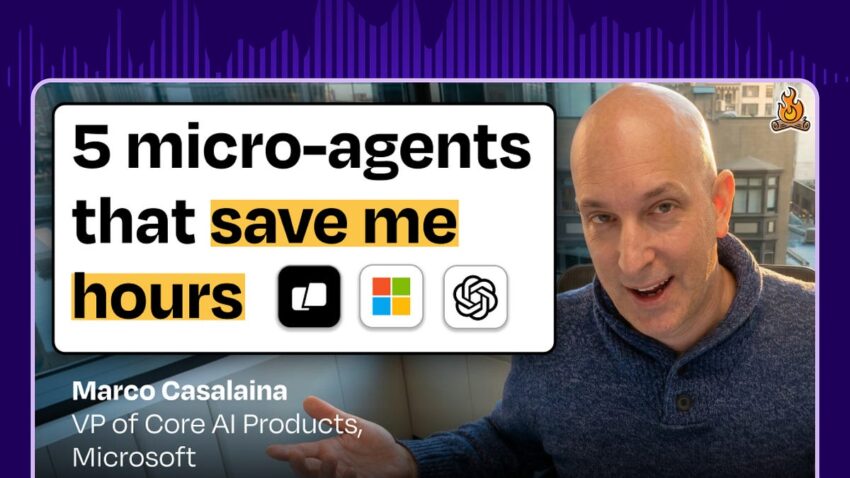
TL;DR Summary of How AI-Powered Micro-Agents Revolutionize Automation with Warp and Microsoft 365 Copilot
Optimixed’s Overview: Harnessing AI Micro-Agents for Seamless and Efficient Automation
Introduction to Micro-Agent Automation
Marco Casalaina, VP of Core AI Products at Microsoft, showcases how lightweight, AI-powered micro-agents can be created spontaneously to automate diverse tasks. These agents, built using tools like Warp, Microsoft 365 Copilot, and ChatGPT, perform specialized jobs such as Azure administration, document scanning, and video file processing without requiring permanent workflows.
Key Benefits and Use Cases
- Hardware Automation: By integrating Warp with CLI tools like NAPS2, users can control hardware devices (e.g., scanners) through AI, enabling document scanning and PDF management without manual software interaction.
- File Manipulation: AI agents analyze and optimize large media files, such as compressing a 1.7GB video to 13MB while preserving quality by adjusting bitrate and resolution using FFmpeg.
- Ad Hoc Micro-Agents: These ephemeral agents handle specific, on-demand tasks, offering flexibility and efficiency compared to traditional, complex automation workflows.
Transforming User Interfaces with AI and CLI Tools
Complex systems like Azure permissions pose a challenge for traditional graphical user interfaces. AI-enhanced command-line tools provide a superior interface by abstracting complicated commands into conversational, easy-to-use agents. This fusion simplifies management and accelerates task completion.
Conclusion
The rise of AI micro-agents represents a paradigm shift in automation, enabling users to delegate repetitive or complex tasks to intelligent agents on the fly. This innovation empowers professionals to concentrate on strategic work while AI handles operational details with precision and ease.