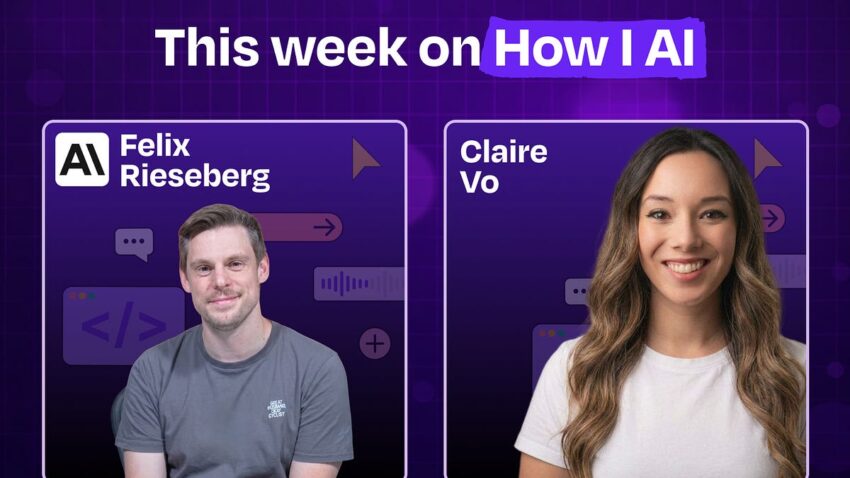
TL;DR Summary of How Felix Rieseberg Leverages Claude AI to Revolutionize Personal and Work Productivity
Optimixed’s Overview: Unlocking Everyday AI Potential with Claude and Google’s Emerging Tools
Felix Rieseberg’s Practical AI Workflow Innovations
Felix, engineering lead at Anthropic, shares a hands-on approach to integrating Claude AI into daily life and work, illustrating how AI can solve mundane problems and enhance creativity.
- Automated Personal Inventory Management: By parsing years of purchase and confirmation emails, Claude builds a 3D floor planner complete with actual furniture dimensions, showcasing AI’s ability to transform unstructured personal data into actionable insights.
- Live Artifacts and Dashboards: Claude’s live artifacts continuously update personal dashboards by integrating with apps like Spotify, Gmail, and Notion, eliminating manual data refreshes and streamlining productivity tools.
- Model Selection Strategy: Felix recommends using Sonnet for well-defined tasks and Opus for interpreting complex or ambiguous requests, illustrating the importance of matching AI capabilities to problem scope.
- Psychological Shift for AI Adoption: Adults often underestimate AI’s potential due to ingrained beliefs about computers’ limitations. Felix encourages adopting a childlike curiosity and willingness to experiment with AI capabilities.
- Collaborative Debugging: Instead of blaming Claude for mistakes, Felix suggests refining prompts and workflows, treating AI as a collaborator that requires clear instructions.
Google I/O 2026: A Mixed Bag of Cutting-Edge AI Tools and Unfinished Features
Claire’s live testing of Google’s latest AI launches reveals promising innovations alongside significant usability gaps.
- Gemini 3.5 Flash: A fast and capable coding AI model competing strongly on benchmarks, potentially reshaping developer preferences for rapid, high-reasoning coding tasks.
- Antigravity 2.0 IDE: Introduces project management and scheduled tasks but mainly plays catch-up with competitors like Claude Code, prioritizing speed over novel features.
- Google AI Studio and Workspace Integration: Promises seamless no-code app building using Google’s ecosystem but suffered from accessibility issues during testing, highlighting a gap between announcement and delivery.
- Omni and Flow Video Tools: Focus on production-quality, consistent video creation with conversational editing, although some core features remain unreliable.
- Design and Marketing Tools (Stitch & Pomelli): Show potential for AI-driven brand asset generation but currently produce generic results, indicating room for creative refinement.
- Multimodal Strength: Gemini models excel at integrating text, images, and video, offering best-in-class performance for complex content generation workflows.
- Launch-to-Availability Challenges: Frequent broken features and “coming soon” labels undermine user trust and slow adoption despite the tools’ impressive capabilities.
Key Takeaways for AI Users and Builders
Felix’s insights combined with Claire’s Google I/O analysis reveal a landscape where AI’s potential is immense but requires user mindset shifts and patience with evolving technology. Embracing AI as a creative collaborator, focusing on workflow refinement, and selecting appropriate AI tools for each task can unlock productivity gains. Meanwhile, developers must bridge the gap between ambitious AI feature announcements and reliable user experiences to maintain trust and drive adoption.