TL;DR Summary of AI Search Traffic vs. Organic Search: Key Insights from April 2026 Semrush Data
Optimixed’s Overview: Understanding the Layers and Impact of AI Search Traffic Versus Organic Search in 2026
1. AI Traffic Remains a Small Fraction Compared to Organic Search
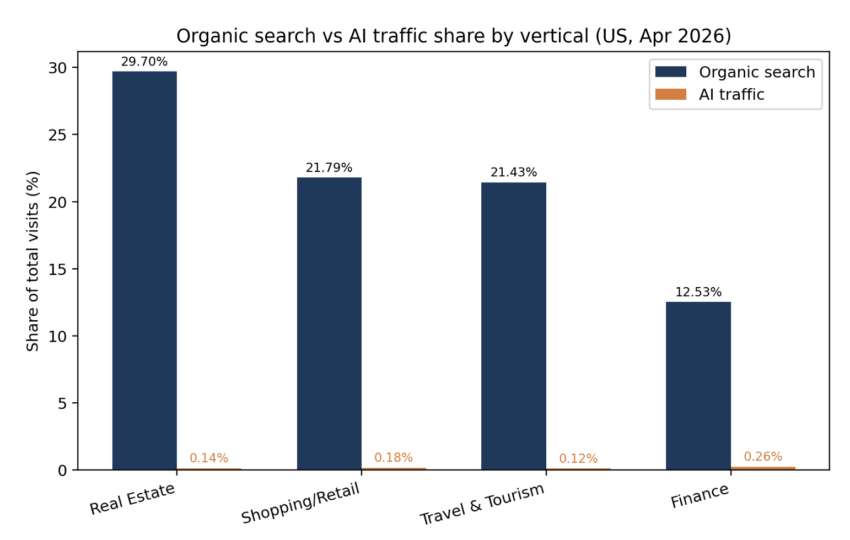
Analysis of April 2026 USA Semrush data across Travel & Tourism, Finance, Real Estate, and Shopping/Retail verticals shows organic search continues to dominate website visits. Organic search accounts for roughly 20.45% of visits, while AI traffic only accounts for 0.19%, making organic search about 108 times larger in traffic volume than AI referrals. This disproves the narrative that AI search is overtaking traditional SEO traffic at scale.
2. AI Citations and AI Traffic Represent Different Layers of User Interaction
- AI citations represent pages that AI systems reference or surface in answers, mainly encompassing discovery and evaluation content like guides, category listings, and policy pages.
- AI traffic reflects where users or AI agents click, heavily weighted toward brand homepages, transactional pages, and operational flows such as login and checkout.
This separation shows AI citations provide a wider visibility and evidence layer, while AI traffic is the measurable click endpoint, often later in the user journey.
3. Vertical Differences Highlight Unique AI Search Dynamics
- Travel & Tourism: AI citations emphasize planning and evaluation (e.g., flight info, baggage policies), while AI traffic favors brand and booking pages.
- Finance: AI traffic is skewed by workflow URLs (notably Stripe) representing login and transaction flows, whereas citations focus on educational and product comparison content.
- Real Estate: Organic search leads traffic by a wide margin; AI citations include local and housing market tools, but AI traffic is mostly homepage visits.
- Shopping/Retail: Exhibits the highest AI traffic volume and citation density with AI citations distributed across product listings, store locators, and editorial pages, while AI traffic centers on brand and operational URLs.
4. The Importance of Segmenting AI Search Metrics for SEO and Marketing
Combining AI presence, citations, and traffic into a single metric misrepresents AI search’s impact. Instead, marketers should:
- Measure AI presence to track brand visibility in AI-generated answers, regardless of clicks.
- Analyze AI citations to understand which URLs support AI content and influence discovery and evaluation.
- Track AI traffic to capture measurable referral clicks and user actions.
- Segment by page type (homepage, category, product, support, checkout, OAuth) to avoid misleading conclusions.
- Consider traffic ownership to identify who ultimately captures the commercial value, especially in marketplaces and ecommerce.
5. Implications for AI Search Optimization
Effective AI search optimization requires a dual focus:
- Optimize discovery and evaluation pages that AI systems cite to ensure accurate, trustworthy, and comprehensive answers.
- Prepare brand-entry and action pages to convert traffic that arrives after AI-guided evaluation.
Additionally, AI search reporting must differentiate between human user clicks and AI agent-driven workflow interactions, which can skew data (e.g., Stripe’s transactional URLs).
6. Key Takeaway
AI traffic is currently a minor but meaningful component of digital visits compared to organic search. However, AI citations reveal a broader and more complex influence by AI on user discovery and evaluation processes. Proper AI search strategy demands analyzing these layers separately to understand true AI impact, optimize relevant content, and accurately attribute business value.