TL;DR Summary of Expanding the Definition of Web Search Beyond Traditional Engines
Optimixed’s Overview: How Search Behavior Is Evolving Across Diverse Digital Platforms in 2025
Broadening the Scope of Search
For over two decades, search was synonymous with Google and a few other traditional engines. However, recent data reveals that search activity is widespread across various platforms, including AI-powered tools, social networks, e-commerce sites, and content platforms. This expanded view recognizes that users conduct queries and seek answers in many places beyond just conventional search engines.
Key Findings from the 2025 Desktop Search Study
- Google’s Market Share: In the US, Google held approximately 73.7% of desktop searches across 41 analyzed domains in Q4 2025, lower than previously reported figures that exceeded 90%.
- Other Major Players: Amazon, Bing, and YouTube each had more search activity than ChatGPT, reflecting diverse user preferences for finding information and products.
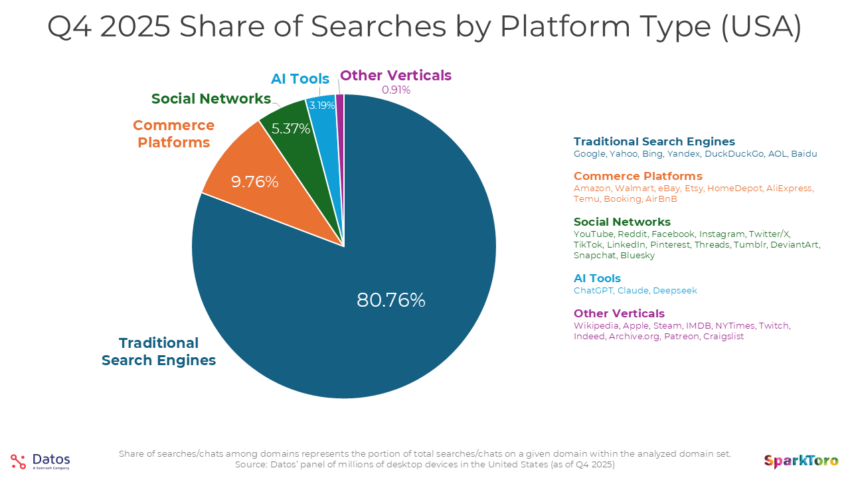
- Category Breakdown: Around 80% of searches occurred on traditional search engines, ~10% on commerce sites, ~5.5% on social platforms, and 3.2% via AI tools.
- Regional Variations: In the EU/UK, Google’s dominance was stronger (~80%), with slightly higher adoption of AI tools like ChatGPT compared to the US.
Search Behavior Insights
Not every visitor to a domain performs searches; for instance, approximately half of eBay and ChatGPT visitors engaged in actual searching or prompting. This distinction between visits and active search prompts is crucial for accurately assessing platform usage.
Search Volume and User Engagement Trends
- Google, DuckDuckGo, and Amazon maintained steady search volumes per user over 2025, while Bing experienced a slight decline.
- Emerging platforms like Threads showed remarkable growth in search activity per user, reflecting shifting user engagement.
- Smaller sites beyond the top seven in search share are gaining ground, indicating a diversification of search destinations.
Implications for Marketers and SEO Strategies
The research suggests that search is a behavior, not confined to a single channel. Therefore, marketers and SEO professionals should adopt a comprehensive approach called Search Everywhere Optimization, ensuring visibility across traditional engines, AI tools, e-commerce marketplaces, and social platforms. Relying solely on Google or emerging AI tools overlooks substantial search activity on other domains where audiences are active.
Methodology and Considerations
This analysis is based on extensive clickstream data from millions of desktop devices in the US and Europe throughout 2025, covering 41 major domains selected for relevant search behavior. Mobile search and app usage were excluded, suggesting that overall search diversification may be even broader than reported. Additionally, the study treats all search queries and AI prompt sessions equally, despite differing user intents and interaction complexities.
Conclusion
Search in 2025 is multifaceted and distributed across traditional engines, AI tools, e-commerce, and social networks. Google remains dominant but less so when considering the full spectrum of search activity. Recognizing and optimizing for this diverse search landscape offers significant opportunity for brands to connect with their audiences wherever they seek information and solutions online.