Skip to content

Today’s SEO & Digital Marketing News

Where SEO Pros Start Their Day

Menu
  • SEO News
  • AI & LLM
  • Technical SEO
  • JOBS & INDUSTRY
Menu

Never Ask an AI Tool How It Came Up with That Answer – SparkToro

12/11/25
Source: SparkToro by Rand Fishkin. Read the original article

TL;DR Summary of Understanding the True Nature of AI Language Models

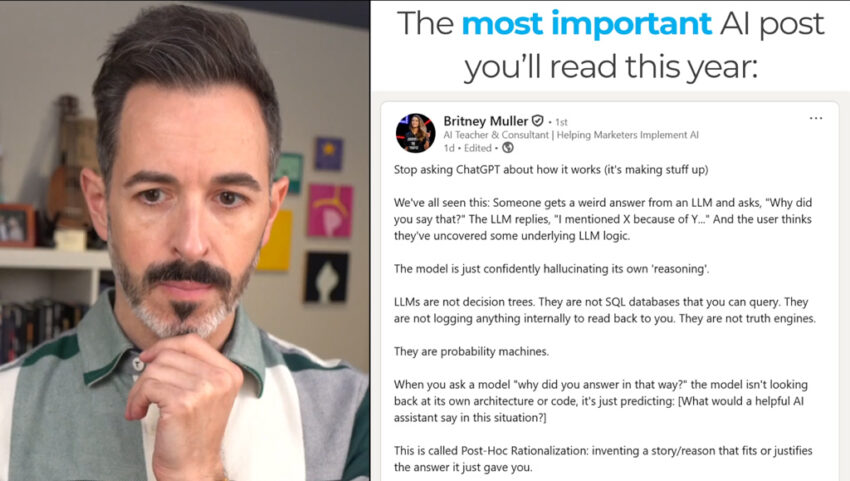
AI language models like ChatGPT and Claude operate as probability-based token predictors, not truth machines or databases. Their answers are generated by statistically selecting the most likely next words, which means their explanations about how they arrive at answers are often fabricated. Understanding this statistical “spicy autocomplete” nature is crucial to properly interpreting AI outputs and avoiding misplaced trust in their reasoning.

Optimixed’s Overview: Why AI Language Models Are Statistical Predictors, Not Knowledge Engines

The Core Reality Behind AI Responses

Many users mistakenly believe that AI systems like ChatGPT explain their answers by revealing their sources or internal logic. In truth, these models do not possess self-awareness or access to their neural network workings. Instead, they function as statistical lotteries, predicting the next token based on probability distributions learned from vast text data.

Key Points About AI Language Models

  • Not Databases: LLMs don’t store or retrieve factual data like a SQL database; they generate answers dynamically based on token probabilities.
  • Hallucinated Explanations: When asked why they gave a certain answer, models fabricate plausible-sounding reasons because they can’t introspect their decision-making processes.
  • Retrieval Augmented Generation (RAG): Some models integrate external information (e.g., search engine results), but still rely on probabilistic token selection to produce text.
  • Variability in Answers: The same question posed multiple times can yield different responses, demonstrating the randomness and subjectivity in token prediction.

Implications for Users and Professionals

Recognizing that AI language models are fundamentally probability-based autocomplete machines helps users set realistic expectations about their capabilities and limitations. Misunderstanding this can lead to misplaced trust, flawed decision-making, and overreliance on AI-generated explanations or facts.

For anyone leveraging AI in professional or personal contexts, a critical, informed perspective on how these models operate is essential to harness their power responsibly and effectively.

Filter Posts


Latest Headlines & Articles
  • Search Engine Land celebrates its 19th birthday
  • Is Google’s AI Calling Your Business? My Experience with AI Price-Checking for a Haircut – Sterling Sky Inc
  • Google December 2025 core update rolling out now
  • Senior SEO Project Owner (High Agency) ~ PRIVATE ~ $60k-70k USD ~ Remote (WW)
  • Bing tests Google-style “Sponsored results” grouping
  • SEO Specialist ~ Dean Garland Inc. ~ In-office (USA) ~ Saint Augustine, FL, United States
  • Meta Outlines Latest Data on Content Removals and Fake Accounts
  • Pinterest Acquires CTV Ad Platform tvScientific
  • From SEO to algorithmic education: The roadmap for long-term brand authority
  • ‘Operation Bluebird’ Aims to Re-Awaken Twitter Trademarks

December 2025
M T W T F S S
1234567
891011121314
15161718192021
22232425262728
293031  
« Nov    

ABOUT OPTIMIXED

Optimixed is built for SEO professionals, digital marketers, and anyone who wants to stay ahead of search trends. It automatically pulls in the latest SEO news, updates, and headlines from dozens of trusted industry sources. Every article features a clean summary and a precise TL;DR—powered by AI and large language models—so you can stay informed without wasting time.
Originally created by Eric Mandell to help a small team stay current on search marketing developments, Optimixed is now open to everyone who needs reliable, up-to-date SEO insights in one place.

©2025 Today’s SEO & Digital Marketing News | Design: Newspaperly WordPress Theme